I quit Portland Bird Obs early doors and headed eastwards into Purbeck, home of magnificent heathlands, rolling downs and one particular plant that I fully intended to track down. Purbeck is an absolute Mecca for the botanist. Had I been visiting in midsummer I wouldn't have known which way to turn next, such is the range of plants present. But I was here on a decidedly cool, early February morning and my focus was squarely centred on Stoborough Heath, site of my target plant.
I parked up and jumped a fence (doubtless there's a proper car park and entrance area, but I don't know where that is) and ducked my way through a gorse dominated slope until I emerged in the open. I scouted around for a wetter area, which didn't take too long, and set about trying to find my plant. A few minutes later and
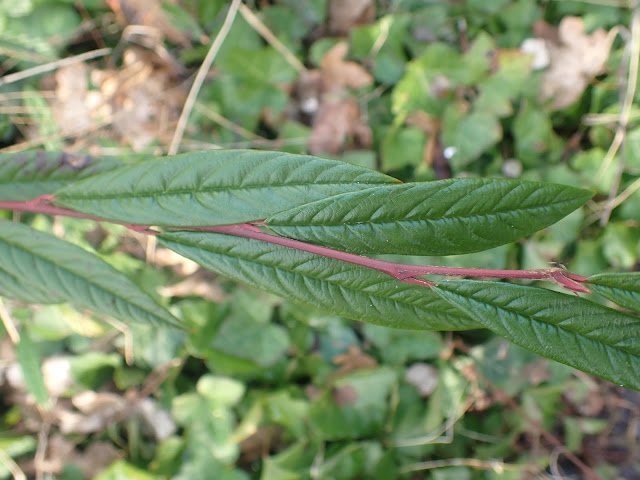
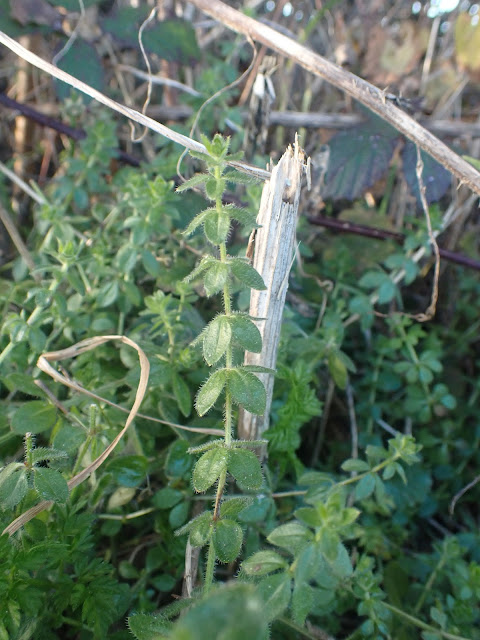
Dorset Heath Erica ciliaris on a Dorset Heath! Note the long glandular hairs on the leaves
Well that was easy! I found quite a few clumps of Dorset Heath growing in wetter patches, along with Bell Heather, Heather and a bit of Cross-leaved Heath. Lots of Dwarf Gorse mixed in too, though I didn't see any Western Gorse (not that I looked too hard, to be fair).
My next target was a plant that grows near the main carpark at Hengistbury Head. I was fairly certain I'd seen it before, I just hadn't known what it was at the time. I was amazed quite how long it took me to weave my way around Poole and down to Hengistbury Head, far longer than I'd expected. There's a small reserve somewhere in Poole that has Bristle Bent, Heath Grasshopper and Sand Lizards. I think I was fairly close to it at one point, several of the roads looked familiar, but I missed the entrance. Not that I'd expect to find much in it at this time of year anyway. Finally, I arrived at Hengistbury Head.
I rather messed up at the pay and display meter, grabbing two hours' worth of parking time, then crossing the road and coming face to face with my target plant all of 90 seconds later. Ho hum, I'll know for next time! This is it, Lavender-cotton in all of its fluffy bobbly glory
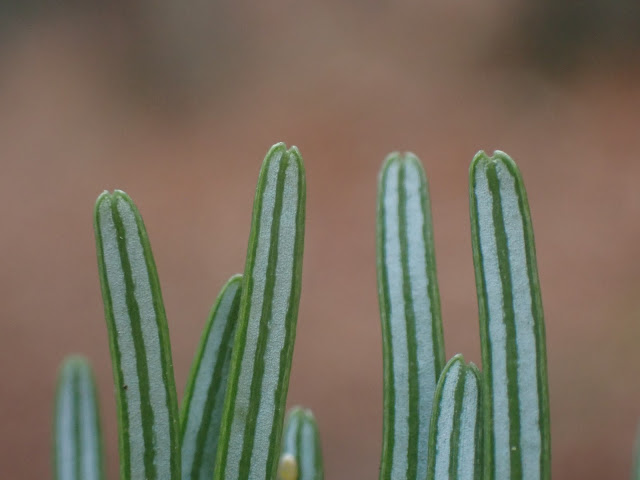
Lavender-cotton Santolina chamaecyparissus
In the summer months this shrub is adorned with glorious yellow flowerheads. But obviously, as I keep saying, things just ain't like that in early February! Still, it's a pleasantly curious plant and I was happy to spend a little time trying to get to grips with how the leaves all fit together so tightly (heck, I still had an hour and fifty seven minutes left on the parking ticket, what else was I supposed to do?) Actually, I did go for a wander, but couldn't find anything of particular interest so I sped off eastwards some more. I had to be in Epsom that evening and I had a few pitstops to fit in first.
Tree Lupin Lupinus arboreus - very common along this stretch of coastline
I planned to head into North Hampshire before swinging east into Surrey for the night. As I found myself approaching Ringwood, I suddenly remembered a churchyard that The Ghost and I had visited a few years back. We'd twitched some weird snowdrops, I couldn't recall the exact details but I thought we'd been after Greater and Green Snowdrops. I wasn't entirely certain where the church in question lay, but it was somewhere near Blashford Lakes. I detoured and, miracle of miracles, took the correct side road and soon found myself parking up outside of Ellingham Church (also known as St Marys Church, I think). Out of respect, I dodged around a handful of gravestone visitors and surreptitiously scanned the drifts of snowdrops for any that looked different. I found quite a few 'Flore Pleno' examples, but they weren't what I was after. Finally, I found a clump that towered above the rest. Greater Snowdrop was quickly added to the bulging yearlist, number 439 in fact!
Greater Snowdrop Galanthus elwesii (alongside Common Snowdrop in lower two images)
It's certainly a bit of a beast! In fact there's a variety named Big Boy, would you believe. Despite quite a lot of searching, I failed to find any other snowdrops other than the bog standard Galanthus nivalis. However, I did find a super-bright patch of Winter Aconite
Winter Aconite Eranthis hyemalis - I've still never seen this plant outside of a churchyard!
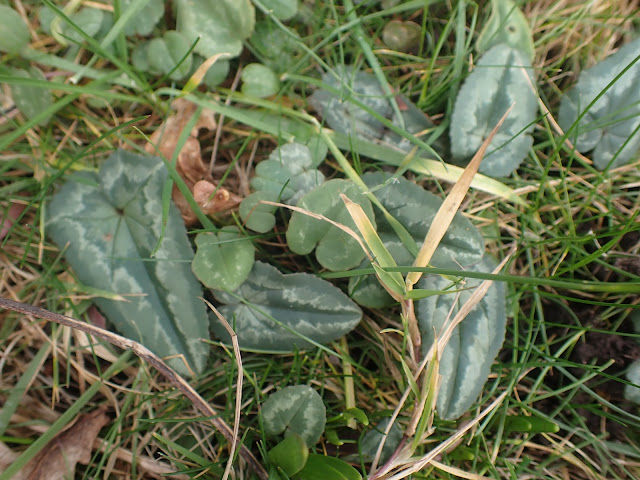
Somewhat more elongated than I'm used to seeing, but I think this is still Cyclamen hederifolia
Back on the road again, I steered The Gibstermobile steadily northwards and eventually arrived in the backstreets of Fleet in North Hampshire. I parked up and walked a woodland path that split and meandered its way through some very nice-looking damp woodland. Surprise surprise, I found a stand of Broad-leaved Bamboo. Bloody stuff is everywhere I look nowadays (seeing as I only ticked it a little less than 3 weeks ago!)
Broad-leaved Bamboo Sasa palmata naturalised in woodland
I suspect the bamboo came out of one of the gardens that backs onto this woodland. If you look closely, you can see fence panels in the background. That's how close to the gardens I was at this point. Happily, the woodland improved with increased distance from the properties. There were masses of Dryopteris ferns (there's a very good one in here too, but it's supposed to be deciduous and I'm very wary of attempting the male-ferns in the absence of a proper grown-up) which I studiously ignored. I was here for one particular plant, a lifer for me if I could find it. I was looking for a cuckoo-flower, but one that was just a little larger than usual...
Greater Cuckoo-flower Cardamine raphanifolia - just a smidge larger than ordinary Cuckoo-flower!
My hands aren't particularly large, certainly nobody would describe them as shovels, but they're not precisely petite either. So I've included a full-sized Lesser Celandine leaf in the lower image, just for scale. I'm not certain, but I think Greater Cuckoo-flower's binomial translates something like 'radish-leaved'. Basically, it's one big bugger of a Cardamine! There was a good fifteen metres of streambank covered in the stuff, must look glorious when it's in flower. But, this being early February.........
I also found a small pool smothered in Least Duckweed Lemna minuta. We don't get this up north
Happy with the Greater Cuckoo-flower I headed into Surrey, my old home county and familiar territory. I'd be staying with friends for the next few nights, but seeing as I wasn't due to arrive for another couple of hours, I headed to a small woodland which I knew held a couple of very desirable trees. Brace yourselves, I hope you aren't expecting high quality pics
I'm pretty sure these will be the worst Field Maple Acer campestre pics you'll see today
I've seen precisely one Field Maple on Skye, and that was planted. It just doesn't occur as a wild tree up there. In fact, once you're past Glasgow, it's decidedly rare all the way up the West coast of Scotland. Hence I definitely needed to secure it whilst down south and this patch of woodland is easily the best site I know for it. It's alright to laugh if you like, I won't mind.
The next tree wasn't on my radar, mainly because it's so common I hadn't even thought about it. It even occurs on Skye. But it was my first of the year so pics were duly taken.
Wild Cherry Prunus avium - the book is Poland's Winter Twig Key
I brought my Field Key to Winter Twigs with me for just such an occasion. As per The Veg Key, this masterpiece of a book is written by John Poland. It's not as easy to use as the Veg Key (or so I've found) and some of the terminology is bizarre. But there's a comprehensive glossary and undoubtedly it will become easier to navigate the more I use it. But I was here for a different tree, of which several grow close together, somewhere near the edge of the woodland. After fifteen minutes of scouting around, I was starting to think I'd fail to find them. But my memory was playing tricks with me, they were further into the wood than I remembered
Wild Service-tree Sorbus torminalis - get in!!!
Wild Service-tree is essentially absent from Scotland, so once again I was very pleased to catch up with it whilst down south. Twenty years ago, I used to search these very trees for larval Phyllonorycter mespilella, which is a tiny moth that feeds on Wild Service-tree leaves. I never found it, just the far commoner Phyllonorycter corylifoliella.
Talking about hunting for moths in Surrey, are you ready for a Blast from the Past piccie?
This was taken on Bookham Common in the summer of 2007. We were in the latter stages of fieldwork for the forthcoming Smaller Moths of Surrey. As Jim Porter himself commented, never in the history of mankind have so many shit-hot lepidopterists gathered together in Surrey. Plus me. I was there too, stood right beside a very youthful-looking Ghostie.
Anyway, I didn't go to Bookham Common during my stay in Surrey. I didn't see any lepidopterists either, shit-hot or otherwise. But before I left this particular patch of trees, I spied a most unexpected sight
Spanish Dagger Yucca gloriosa var recurvifolia - with the Winter Twig Key for scale!
Clearly these are in close proximity to a garden fence. There's actually a small road that runs between that fence and the woodland where these Yucca are growing. I can only assume they've been either planted out (seems unlikely, the entrance to the property is a bit of a way from those fence panels you can see in the pics) or they've been chucked out as garden waste, possibly by a fly-tipper from elsewhere, and have subsequently rooted and flourished. This seems more likely to my mind, it's a very secluded road and any garden waste fly-tipping would largely go unnoticed. Anyway, a surprising find however they got there! I've seen Yucca in the sand dunes on Tresco; they've been there for decades, are self-seeding and are properly naturalised, hence I suffered no moral quandries with these particular plants. They still went on the yearlist though.
My time for botanising was up, I headed across to Epsom just in time for dinner. Oh, and to meet up with some very dear friends, first time in nearly three years apparently. My plant yearlist stood at 444 species. Crazy.
So apparently my choice of toonage is still too obscure for some.... Here's one that (surely!) everyone knows. It's not linked to anything in this post, it's just a damned good song. This is the Black Crowes covering an Otis Redding song, it's possibly the best known version anyway. Hope you enjoy (and have heard of it)!
In an effort to bring this blog back up to date, I'm going to amalgamate several days' worth of Hampshire plant-bothering into one blogpost. I'll try to keep it concise...
Thursday 27th January was spent in the New Forest looking at some rare fungi and finding a pretty smart alien flatworm in leaf litter. We headed to Ridley Wood where we noted a few decent species, though the plants themselves were somewhat less interesting. Note the 'absent' ground flora in the middle image below - those bloody ponies definitely need to be culled!
Gorse Spider Mite webs all over Gorse bushes
A great habitat for saproxylics and decomposers!
Fallen beechmast is the sole host for the tiny Xylaria carpophila. Weird but true
Rare bracket fungi were duly found in Ridley Wood. We then set off in search of Grand Fir Abies grandis in another part of The Forest. An hour or so later
Grand Fir Abies grandis. Note the real needle in the second pic
Looking around we soon noticed that, despite its apparent lack of cones, there were quite a few Grand Fir seedlings scattered across the immediate area beneath the tree. They must be hidden way up in the canopy, I guess.
Further into the woods we started finding small seedlings of a different conifer species. Happily they keyed through without any difficulty, another yeartick though not a lifer for either of us
This is Lawson's Cypress Cupressus lawsoniana. Note the mine in the bottom image
The mine is caused by a tiny moth, the larvae of which bore into and then consume the contents of the leaf scales. There are two species of moth that do this in Britain, and you'd need to rear the larva through to adulthood to be sure of the identity. However, seeing as this is on Lawson's Cypress and not Leyland Cypress, I think Argyresthia trifasciata is the more likely of the two. Ghostie will doubtless disagree with me, he does like to pretend he knows a thing or two about moffs...
A fine example of Polypodium interjectum. Note how the outer sori are ovoid rather than rounded
The following day was largely spent indoors sorting out a few bits and bobs, though we did pop out to see Maidenhair Fern growing on the walls of a crypt entrance.
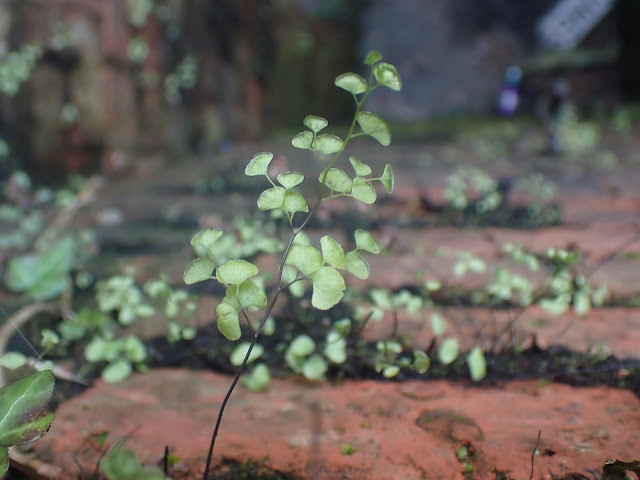
Maidenhair Fern Adiantum capillus-veneris - I definitely won't see this when I'm back in Scotland!
Mistletoe Viscum album clearly doing exceptionally well in this part of Hampshire!
We hit Gosport on 29th January, though it failed to deliver several species that were initially on our radar. However, we stumbled across a healthy patch of Wood Small-reed which was an unexpected bonus
Wood Small-reed Calamagrostis epigejos - a little past its best but still perfectly key-able
Other plants of note around Gosport were Equal-leaved Knotgrass, Hoary Plantain and Large Bindweed, which despite not having any flowers still managed to key through convincingly. Once again I feel the need to say that Poland's Veg Key is a truly marvellous piece of work.
Heading inland we visited several sites, hoping to take shelter from the chill wind in tall woodlands. We were on the chalk, so the flavour of plants changed somewhat. Wayfaring-tree and Common Whitebeam quickly threw themselves onto our lists at Head Down, but no sign of the Common Gromwell (edge mowed) or Deadly Nightshade (presumably not visible in the winter months) that we'd seen here on a previous visit several years back.
Wayfaring-tree Viburnum lantana terminal bud
The woods, in all honesty, were pretty dead. Probably something to do with it being a chilly day in late January... We changed tack and headed towards a village pond that The Ghost knows so I could yeartick some clearly planted and hence uncountable Hybrid Crack-willows. He tried to persuade me to add some equally dodgy Lesser Periwinkle in a flowerbed to my yearlist. Happily I resisted on both counts, though I sure as hell counted the flowering Winter Aconite I spotted as soon as we entered the village churchyard!
Winter Aconite Eranthis hyemalis - just the second time I've encountered this delightful plant
Ghostie was instantly full of cheer and grins, finding Winter Aconite was not in our minds, so to unexpectedly stumble into this little clump was a sheer delight. We took a few piccies and checked what the book had to say about them before I heard a smiling Ghostie say "that's absolutely made my day". Blimey, was he feeling alright? I didn't even know he could smile!
Our last site for the day was Petersfield Lake so I could fill my boots with "utter dross" like Mute Swan, Greylag Goose, Tufted Duck and, worst of all, Egyptian Geese. We do have small numbers of Tufties overwinter on Skye, but Mute Swan would cause a stampede were one to turn up. However, we still found a few plants of interest (of interest to me, at least), the best of which was this stunner
This is Greater Celandine Chelidonium majus, completely absent from the Skye area and a plant I was very much hoping to catch up with. The yellow sap was used by the Victorians in rather an interesting way; it was used as a beautification agent, dab it into a lady's eye and her whites would brighten, seemingly an appealing feature back in the day. However, over-dabbing could lead to permanent blindness. Bit risky if you ask me, and I wonder how many blinded ladies it took before they realised what was happening. I didn't try it out for myself and Ghostie didn't offer his eyes when I told him of its remarkable attributes. Such a wuss.
Sunday 30th January was our Big Day. First up was Port Solent near Portsmouth for a couple of highly desirable plants. The first grows between paving cracks in a certain car park. Rather annoyingly, from our perspective, the car park in question was out of bounds for the day thanks to a car show that was taking place. We were denied access by a marshall, Ghostie traded a few choice words with the guy, and we roared off to another carpark to try our luck there. Happily, our target plant was soon found and all grievances were quickly forgotten.
Small Goosegrass (aka Small Cleavers) Galium murale with Cleavers alongside for scale
Happy to have found 'our own' Small Cleavers away from the main site (about 50metres away...), we hit the sea wall in search of our next target plant. This fell equally quickly with several square feet of the stuff growing on the seaward side of the wall
This is Thick-leaved Stonecrop Sedum dasyphyllum - it's certainly a bit of a chunky monkey!
We took a brief wander around Milton Common, but the time of year was wrong for our target plants and brambles have seemingly smothered the Grape-vine. Luckily we bagged Ribbed Melilot and Tall Melilot, both of which are decidedly uncommon and scattered north of the border.
We quit Portsmouth, never a bad thing, and headed to Portsdown Hill, home of at least a thousand species of Cotoneaster. Or so it seems, once you're in there. We had old gen for some of them, the main problem being that ongoing scrub clearance and grazing may have destroyed some of the plants we were after. We set off regardless, hoping for a clean sweep but ready to admit defeat if need be. As it transpired, we saw over half the species we tried for.
The Cotoneasters came thick and fast once we were in The Zone. Armed with Stace 4 and Poland's Veg Key, plus a copy of the Hants Flora Cotoneaster Crib, we confidently named some, wavered back and forth over others and basically threw our arms in the air with frustration at others. Six years ago we did this very same Cotoneaster circuit and we cleared up. This time, with more knowledge and better books, we were definitely struggling. Admittedly berries were at a premium and some species were mostly lacking leaves, but it seemed much more of a slog this time around. Random leaf pics below, what do you reckon they are?
Species we were happy with included Cotoneaster x watereri, C.sternianus, C.simonsii, C.divaricatus, C.lacteus, C.salicifolius and I'm pretty sure we also had C.dielsianus and possibly C.vilmorianus. Others were either no longer there, engulfed in thorn scrub or we missed them/didn't try for them. As you can see from the pictures, the weather was truly gorgeous. I was sweating in my hoodie, the coat had long since been bundled into my rucksack. Which probably explains why we found Wild Parsnip in flower. In January....!
We had one last target to check, and we were by now starting to lose daylight. Ghostie was keen. I was keen. We headed off to yet another churchyard. I swear I've spent more time in churchyards this month than does the average priest. Our target was not a plant, but a fungus. Ordinarily I wouldn't besmirch this blog with such a thing, but this one was rather tasty. Not literally! This particular fungus is fully protected by law, so no tasting allowed. Curiously, it was growing inside the base of a gigantic Yew tree! Behold, I give you the rare Sandy Stiltball. And some knobber with his head stuck in a tree.
Honestly, the man knows no shame.....
I ended the day with 368 plant species for the year, far more than I'd hoped to achieve for the opening month of the year. I would start to plateau soon, how much longer could I keep up this ridiculous rate I wondered. Happily, with just one more day left in Hampshire, there was still some juice in the tank.
Monday 31st January saw us drive in convoy into mid-Hampshire for The Ghost to put his car in for service. I'd buzz us around all day until his car was ready, we had a few sites in mind but, after ten days, we were pretty much scraping the barrel for fresh ideas. We both agreed that January was not the ideal time of year for botanising Hampshire.
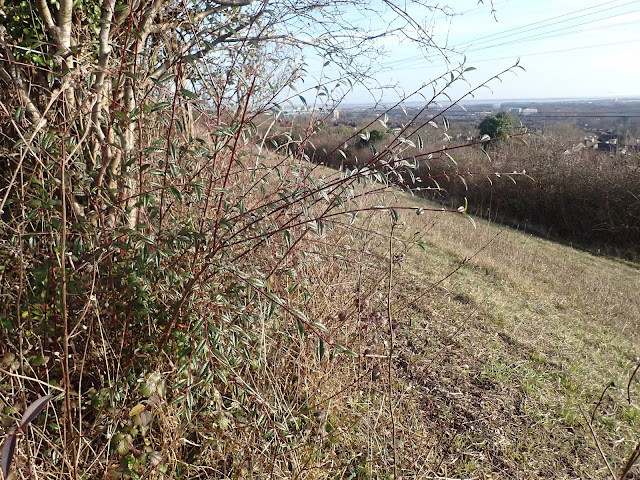
We visited various sites, crossing into West Sussex for a few hours, finally finding Alder Buckthorn (a big relief for me, it's a very scarce plant in Scotland), Least Duckweed, Deutzia scabra and, by the skin of our teeth, Large Thyme in yet another churchyard
Large Thyme Thymus pulegioides alongside Wild Thyme Thymus polytrichus. It's the very hairy one
Next we hit Midhurst and decided to just amble around the pond area then the backstreets in the older part of the town. I'm not particularly familiar with Midhurst, but Ghostie knows it well. He planned to add Mexican Fleabane to my yearlist, with luck. Er yeah, I'd say luck was with us!
Mexican Fleabane Erigeron karvinskianus - sorted!
Continuing along the road we arrived at the pond. Loads of Alder Leaf Beetles overwintering in the fissured bark of a large ornamental conifer were a surprise. They really have expanded their range these past few years. More interesting, especially to Ghostie, was the large thicket of bamboo growing alongside a stream. Damnit, it was one I'd seen in Fife just ten days earlier, not even a yeartick. Worse still, it was a lifer for Ghostie. And did he gloat? Of course he bloody did!
This is Broad-leaved Bamboo Sasa palmata. Not a lifer (for some)
We were finding all sorts of interesting plants along this stretch of stream. Hemlock Water-dropwort and Greater Tussock-sedge were both yearticks for me. I'm not sure I've ever seen Greater Tussock-sedge outside of Scilly and Cornwall, hence I was pleasantly surprised to find it here in West Sussex.
Greater Tussock-sedge Carex paniculata looking like a gorilla in a ghillie suit
Summer Snowflake Leucojum aestivum
We found this plant flowering alongside the stream. I suggested Summer Snowflake right at the very start, but we went wrong in the keys and it actually took us quite a long time to get it to species. I think we keyed it to three or four different species before realising that it does actually have more than one flower per stem (see lower pic, there are three visible inside the sheath). This was another lifer for Ghostie, but the stream had one final surprise for us, a lifer for me too this time!
A proper mystery plant - neither of us had a clue what this was!
The Veg Key proved its worth once more, keying this to Skimmia japonica with very little effort on our part. I've said it before and will undoubtedly say it again, but what a bloody marvellous book it is! I bent a leaf crosswise and grinned when it gave an audible crack as it snapped, a feature specifically mentioned in the key.
Finally we headed back towards the garage, surely Ghostie's car would be ready soon? We hit a plantation woodland, mostly very muddy and quiet though it did have lots of Betony on the tracksides, not a plant I'm likely to see anytime soon back on Skye
Betony Stachys officinalis leaves in the winter sunshine
Our last site for the day was Butser Hill, I think it may be the highest bit of land in Hampshire (don't quote me on that!). The views were intense, the plantlife less so. Incredible bit of habitat though, I expect it's lovely on a warm summer's evening. Pity it was positively frigid in the cold wind today! However, this habitat is perfect for one small plant I was keenly hoping we'd bump into. As luck would have it, there was tons of it around the car parking area
Crosswort Cruciata laevipes - the first I've seen in years!
Finally the mechanic called, the car was ready, I dropped Ghostie at the garage and sped off on one last madcap mission. Ghostie just shook his head in despair. I didn't care, this could be plant of the year and I was not about to leave Hampshire without at least attempting it. Twenty minutes later and.........
Chusan Palm Trachycarpus fortunei - GET IN!!!!
Hardly believing my eyes, I walked a length of verge alongside a busy road in Waterlooville and almost immediately found a whole batch of Chusan Palms in the undergrowth. I immediately noted some suspiciously evenly-spaced Cherry Laurel bushes and initially suspected the palms had been planted by persons unknown. But then I realised that the spacing was random, sometimes two or even three palms in a rough grouping then a long gap to a singleton. Walking further along the pavement I smiled at the sight of many palm seedlings sprouting up through a bed of ivy - these at least were clearly self-sown, and I now suspect the larger plants were too.
So there you have it, my ten day stay with The Ghost was very almost at an end. My final plant was a palm, which kinda sums up the lunacy that happens whenever we get together. I had one more local plant to try for, but I'd do that in the morning before heading westwards into Cornwall. My plant yearlist at the close of January stood at a frankly ridiculous 381 species, of which an incredible 30 were lifers. In January!!! Madness. Ali and The Ghost have a lot to answer for. And an awful lot of catching up to do.
Phew, that was a long blogpost. This is The Limiñanas playing Islanbul is Sleepy. Personally I'm feeling quite sleepy too. More posts soon, at least I'm only a week behind now.