I awoke to discover that the overnight rain had cleared through and, after demolishing a breakfast baguette and coffee from a superbly placed chuck wagon, I set about exploring the corners of Springkerse Industrial Estate, quietly nestled in the eastern outskirts of Stirling. I'd parked in an overgrown layby and noticed a track running through a small slither of woodland and into another road on the estate. I immediately set off to explore. New for year plants here were carpets of Field Forget-me-nots and quite a bit of Perforate St John's-wort, but my eye was quickly caught by a large plant with huge spiky leaves - what the heck was that then?
I admit to suffering a bit of a mind-fart moment at this point. I figured it looked like Bear's-breech but with more spiny leaves. And the stem was clearly bristly. This made it Spiny Bear's-breech Acanthus spinosus, agreed? Stace 4 thought so too, sweet. Ambling my way around the estate it was pretty obvious that it has naturalised very thoroughly in carparks, in roadside verges and across any areas of wasteland. What I didn't do was attempt to run a plant through a key. Very slack and a fine exhibition of poor botany skillz...
Young growth, a paler green than the more mature leaves
I eventually quit Stirling and sped off westwards into Ayrshire, but couldn't shake a niggling feeling that I was overlooking something regards the big-leaved plant. Surely an Acanthus would be more glossy than the leaves I'd seen? Unsure, I continued through the lowlands and it and it wasn't until I got home several days later that a helpful chap on the Scottish Botany FB Group put me right - my plant was young Giant Hogweed Heracleum mantegazzianum! Then another chap waded in telling me not to touch it, that I'd get caustic burns, I'd go blind and then probably burst into spectacular flames, assuming I hadn't already died of lung failure first. I deleted the post in the end, he was doing my head in. My only excuse for not sussing it straight away is that I've only ever seen it ten feet tall in full flower and usually along watercourses, and not for about ten years now anyway. That and the fact I'm an idiot.
Me touching Giant Hogweed (moments later my hand turned black, withered and fell off. Obvs...)
I slowly worked my way down towards Ayr. In my early teens I lived here with my grandpa and, though he died some years back now, I always take a wee drive down memory lane when I'm in the area. I did a slow drive around some backstreets, noting that most of the pubs have gone and new cul-de-sacs have sprung up everywhere at some point in the recent past. Taking the coast road southwards I eventually arrived at Benane Head with its Green-winged Orchid populations. I took a fruitess wander around some meadows and skirted a couple of hills with no sign of orchids, quit and tried another area. This time I looked up from the herb-rich grassland I was wandering and spied purple spikes in the middle of a sheep-grazed field - oh right! Quickly hopping the fence, I soon found myself kneeling next to my first ever Green-winged Orchids, and what smart little plants they are too
Green-winged Orchids Anacamptis morio - superb little things!
I had a quick scoot around and counted forty eight spikes in an area of maybe fifty metres by about ten. Doubtless I missed lots, but I didn't fancy inadvertantly trampling on others that may not have developed spikes yet. Very happy to have finally connected with this orchid, I wandered back to the car where I found another spike in the recently strimmed roadside verge.
Early Hair-grass Aira praecox
A terrestrialised water-crowfoot....
Even the experts out there agree that once a water-crowfoot has become terrestrialised, you need to walk away and pretend you never saw it. They do weird things (experts and terrestrialised water-crowfoots both), submerged leaves may not develop (crows-foot only) and they're not exactly easy to identify when they're not doing weird things! The only species that's been previously recorded at this location is Ivy-leaved Water-crowfoot, which it does look good for, but I'll leave it as 'aquatic Ranunculus sp'. Hopefully I'll get another chance with a typical example at some point soon.
Ailsa Craig
As you can probably tell from the images, the weather was absolutely stunning. We could do with a few more days like this on Skye. I wandered my way further south and followed my nose to the pebble beach of Ballantrae. A sudden thought hit me, I had a site for Oysterplant from a pebbly beach somewhere around here. I could picture the aerial pic in my mind, a sharp bend in the road by a long lake at the top of the beach. I looked down the road to where it sharply bent around the corner. Wandering down I spied a long lake....holy shit! I recalled the Oysterplant grew somewhere level with the southern end of the lake, though up on the shingle obviously. I set off full of hope. Ten minutes later and
Oysterplant(lings) - how very bloody marvellous!
I've only ever encountered Oysterplant way up the east coast of Scotland, and it's a long walk along an arduous beach. So to stumble across the best part of ten individual plants a five minute walk from the road was both a massive relief (sore foot, remember!) and a very welcome jam indeed. It's also just a really special plant, there's nothing else out there like it. Pity I was here too early in the season to find it flowering, that would have been the icing on the cake. Then I turned around....
Full-sized Oysterplant in flower!
I had to cast my shadow across this plant, the glare off the pale cobbles was playing havoc with my camera, but it gives a better idea of the true colour of the bluish-coloured leaves. It's a really great plant, such a shame it's becoming rarer and rarer. It used to occur on Skye, but all known plants have now been lost. It could still be clinging on somewhere, I'd love to rediscover it on Skye. It will probably never happen, but I live in hope.
Plenty of other stuff was growing out there in the shingle. Considering this is a popular stretch of coastline and quite close to houses, I'm amazed the vegetated shingle has survived so well
From top to bottom we have Sea Campion, Sea Beet, Common Cornsalad (2 pics) and Sea Sandwort. The cornsalad was a bit of a cheat, what you're meant to do is check the mature seeds, whereas what I actually did was check the distribution and habitat maps. Common Cornsalad is known all along this stretch of coast and occurs on shingle, amongst other habitat types. The other cornsalads don't - simple!
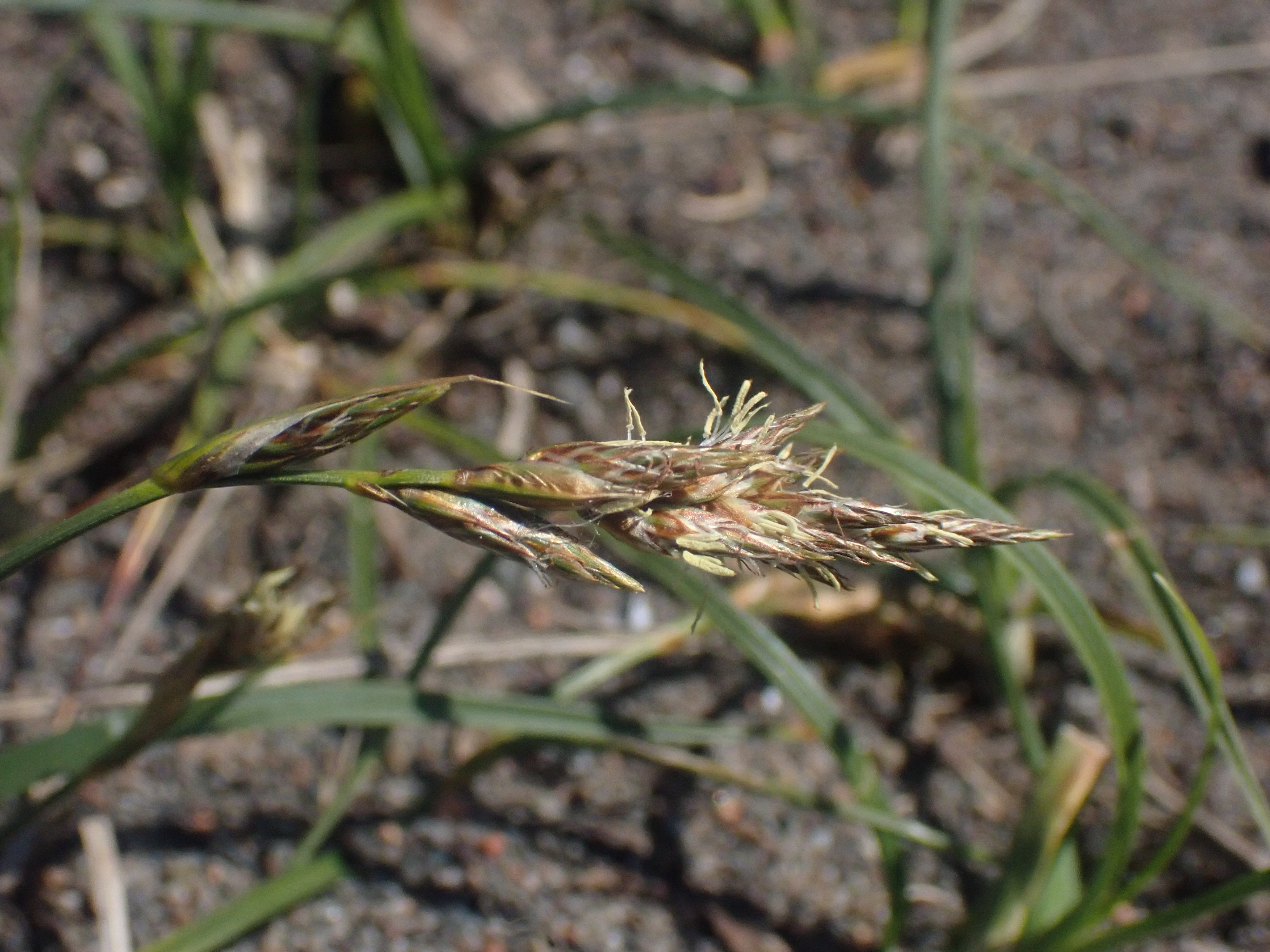
At the top of the beach, where the cobbles end and sandy soil begins, I found another suite of plants. Best of the lot, from my perspective, was Sand Sedge. I refound this at a Skye site where it hasn't been seen since the 1970s, and I've seen in in Cornwall twice. But that's it, so to self-find and identify it at a further site was a nice little bonus for me. My pics are all crap though!
Sand Sedge Carex arenaria and a photogenic set of huts
I turned The Gibstermobile northwards and set off once more, very happy to have stumbled across the Oysterplant and just soaking up the incredible weather. I spied an awful lot of flowering Tuberous Comfrey lining whole stretches of roadside verge and finally found a spot to pull in and check them out properly
Tuberous Comfrey Symphytum tuberosum with nettles on a roadside verge
I took a sprig back to the car and keyed it through properly, just in case. A few miles further up the road I found another layby and another comfrey, which I also keyed through properly
As expected, this is Russian Comfrey Symphytum x uplandicum - a common plant even on Skye
Right next to it was a large stand of Greater Celandine, but with weird over-developed flowering parts. This is Chelidonium majusflore pleno, a garden cultivar that has presumably been dumped here at some point in the past.
I've seen flore pleno Snowdrops fairly frequently, and occasionally I'll see a shrub with flore pleno heads, Kerria japonica springs to mind, but I had no idea that Greater Celandine had ever been cultivated as a garden plant or that they came in a flore pleno form. Google assures me that they really do, so I guess that's what these are. I pulled off a leaf and copious orange latex quickly bubbled to the top, just to double-check.
Water Horsetail Equisetum fluviatile is well and truly on my Ayrshire list
I didn't have gen for anything else down south, so took a long drive northwards, planning to spend the night at Logierait in the Pitlochry area. There were a fistful of plants in the Logierait area that I still needed for The Challenge and although I was pretty sure I still had a healthy lead over Ghostie and Dorset Pete, a few gimme species certainly wouldn't go amiss.
At some point or another I wandered into a random patch of woodland, finding white-flowered Pink-purslane which confused me. I also found a couple of young buck Roe Deer messing around and managed a quick video grab of them. It's not exactly Attenborough worthy, but I thought I'd share it anyway
I later pulled into a layby somewhere along the A9 north of Perth, just for a break from driving. I gave it ten minutes trying to relax and then grew bored. A quick scan around was worthwhile with this tall grass grabbing my attention
Lots of nice obvious features on this grass
If I haven't royally messed up, which is a distinct possibility when it comes to me and grasses, this should be Soft-brome Bromus hordeaceus. That's what I made it anyway. Hairy Tare was another yeartick from the layby, not at all a common plant back on Skye but well distributed in Perthshire.
My final plant of the day was Motherwort, growing in exactly the same place as it was the first, second and third times I saw it. In fact, I've never seen it anywhere else! This is what it looks like after dark
Motherwort by night. Which sounds like the name of a Scandinavian folk band
Motherwort by night was plant species 619 for the year. I'm definitely exceeding my expectations and, as I would soon find out, it was only going to get better tomorrow.
Music time and I'm feeling like something a bit lively and loud. Motörhead were supposedly the loudest band out there, so they'll do just fine. Crank it up, make it worthwhile. Sing for us with that beautiful voice of yours, Lemmy. Hope you enjoy!
Towards the end of March I started making plans to hit the mainland in search of squills, centred largely around the Inverness area. Eventually my day off work arrived and, miracle of miracles, the weather was glorious. Inverness here I come...
I've recently been granted access to the BSBI Database, which allows me to run checks on timings and distributions of pretty much any plant on the British list. So I genned-up beforehand (or cheated, as some may say...) and pretty soon had a fistful of sites lined up to investigate in search of various squills, all alien species and all lifers for me. I set off early and had the road almost entirely to myself as I headed eastwards towards the mainland
Distant view of a snow-capped Cuillin. I'll be heading up that later this year
I made great time and arrived at Urquhart Bay Wood near Lewiston in high spirits and full of anticipation at the thought of finally encountering Alternate-leaved Golden-saxifrage before hitting the various squill sites I'd researched. I wandered the woodland track, GPS turned off and in my bag, hopeful of simply stumbling into the plants as I meandered through the woods. An hour or so later, with no sign of the Alternate-leaved Golden-saxifrage, I succumbed and fired up my GPS, then headed straight to the given griddie. Annoyingly it was a spot I'd already checked; masses of Opposite-leaved Golden-saxifrage but none with alternate leaves. None at all (coz yep, I checked all of them). Well, that was hardly the start I'd hoped for, though I did find a few nice bits in there all the same.
Note how the leaves are all precisely opposite each other and not alternating. Meh...
Lots and lots of the invasive White Butterbur Petasites albus
I've seen White Butterbur once before, a couple of years ago in Perth, but this was the first time I'd seen the flowers. It's a very smart plant, though highly invasive and generally undesirable.
Quite a lot of Daffodil Narcissus sp scattered through the woodland
I don't know the true distribution of Wild Daffodil in Britain, something to look into perhaps, but these clumps were quite a way from the nearest houses. I'd like to be able to identify them beyond 'sp' or 'agg' level but, according to The Daffodil Society, there are over 23,000 named cultivars and, reading between the lines elsewhere, they can be something of a pig to distinguish. One for another time, if ever, I reckon.
Inevitably, as per every other time I've ever attempted to see it, I eventually gave up trying to find Alternate-reality Golden-saxifrage and headed off elsewhere. In this instance that was to a nearby site and the first squill target of the day. It didn't take long to find, in fact it was within about 20ft of where I parked up
Boissier's Glory-of-the-snow Scilla luciliae at Lewiston
Boissier's Glory-of-the-snow really is a beautiful little flower, standing maybe eight centimetres tall and forming an open carpet throughout short grasses at the edge of a woodland track. There are several 'Glory-of-the-snows', all of which are squills. Squill taxonomy is a bit awkward and has undergone several recent changes. For simplicity's sake, I'll refer to all of them by their generic name Scilla.
Scilla don't have their petals and sepals differentiated (most flowers have their non-sexual flower parts seperated into two whorls, sepals on the outside and petals on the inside). When the sepals and petals of a plant have fused into a single whorl they are known as tepals, which in Scilla are coloured various shades of lilac to purple to bluish. Tepals may look exactly like petals, but technically they're different.
Scilla luciliae was a new plant for me, I still needed to key it through to check that I agreed with the given identification, and if not, why not. This one was very simple to identify, it keyed through using Stace 4 as follows (abbreviated version showing relevant half of each couplet only)
1) tepals fused into proximal tube, stamens inserted at apex of tube >>2
2) Perianth blue with a whitish centre zone and whitish filaments >>3
3) Stems all or mostly 1-2 flowers, perianth pale blue distally >> Scilla luciliae.
There's a really decent page on the naturalised squills of Cumbria which is well worth a quick squizz here. It complements the Stace key with colour images and has a lot of hints and tips too. One squill down, several more to go. I jumped back into The Gibstermobile and headed north into Inverness proper.
Ian Green, BSBI recorder for Moray, discovered a mixed colony of squills beneath trees in an urban part of Inverness, and this was where I hoped to find at least three more species of Scilla. I spent quite a while wandering beneath the tangle of trees and shrubs between a residential road and a main carriageway into Inverness centre. Not very scenic, lots of fast-moving traffic, a few weird looks from passers-by but who cares, I was in Scilla Central - they were everywhere!
Quite a few hundred plants in this mixed colony
The larger leaves growing amongst the Scilla is Tuberous Comfrey Symphytum tuberosum which was a new plant for me. I went on to find Tuberous Comfrey at several more sites during the day, it's clearly quite widespread in the Inverness area and I look forward to seeing it in flower a little later into the year.
Young leaves of Tuberous Comfrey Symphytum tuberosum
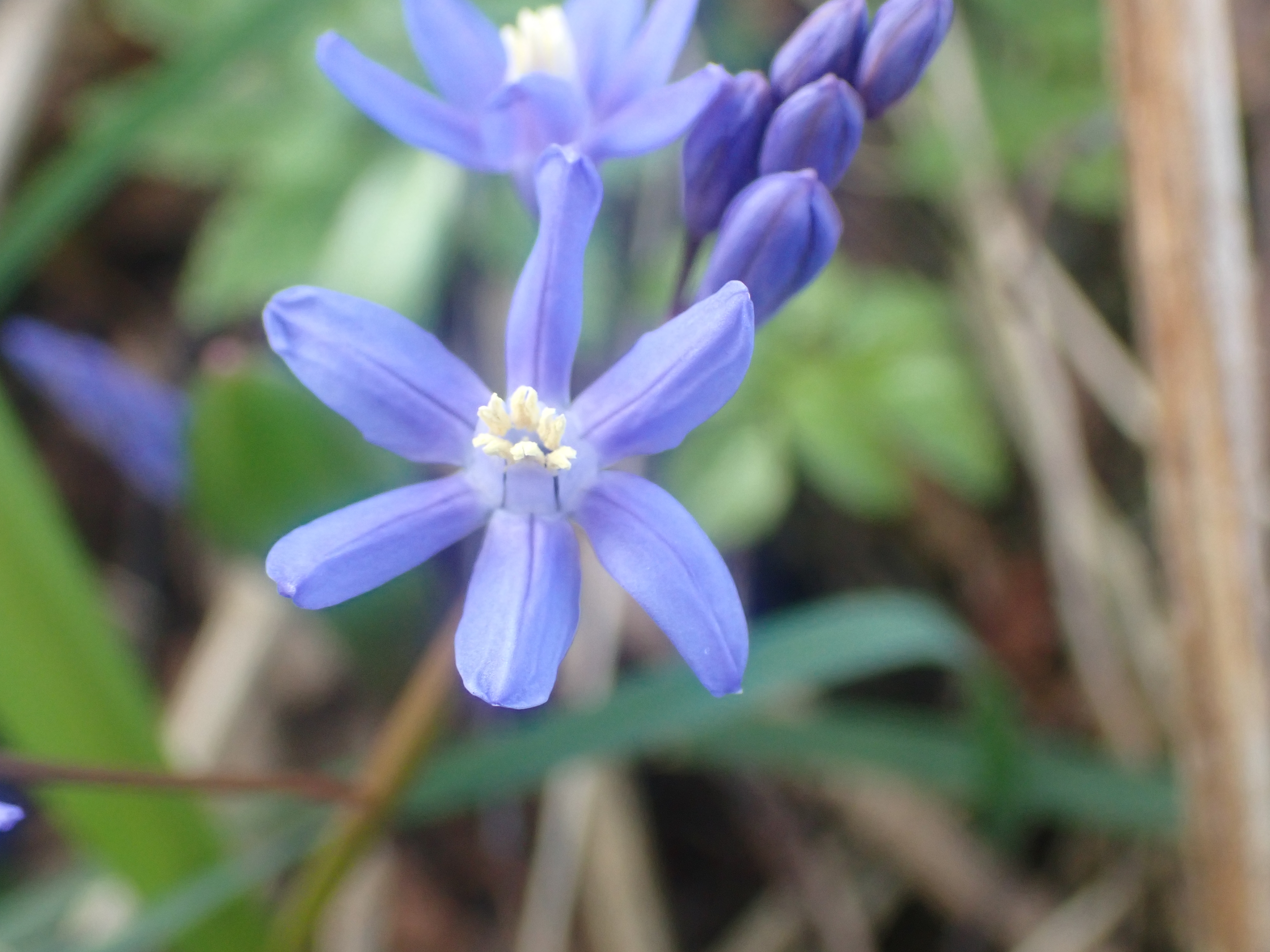
I spent the next hour or so trying to wrap my head around the bewildering display of squills beneath the trees. I eventually came to the conclusion that I had Scilla bifolia, Scilla forbesii, Scilla sardensis and what might have been a weird-looking Scilla luciliae too. Scilla are known to hybridise with each other and I suspected the putative luciliae may have been one such hybrid plant. I took lots of images, just in case.
First up was Scilla bifolia, a true Scilla with the anther filaments inserted at the base of the ovary.
Alpine Squill Scilla bifolia
I used Stace 4 to key the various Scilla in the field. Well, partially in the field and mostly in my car, to be precise. In this instance the key ran as follows (very abbreviated version only):
1) Tepals free, not united into a tube. Stamens inserted at their base, not at the apex >>4
4) Bracts 0 or less than 4mm, not over 4mm >>7
7) Flowers erect to patent, not pendant. Tepals 3-10mm, not 12-16mm >>8
8) Flowering Feb-Mar and has leaves, not flowering Jul-Sep without leaves >>9
9) Leaves (1) 2 (3) sheathing stem between a quarter and a half way up >> Scilla bifolia. Sorted!
Next up was this lovely, all blue beauty.
Lesser Glory-of-the-snow Scilla sardensis
As you can see, I went a bit wrong in the key. Not through any fault of the key, I just read it wrong. Here's the short version:
1) Tepals united into proximal tube >5th their length, stamens inserted at apex of tube >>2
2) Perianth wholly blue but filaments white >> Scilla sardensis. Easy!
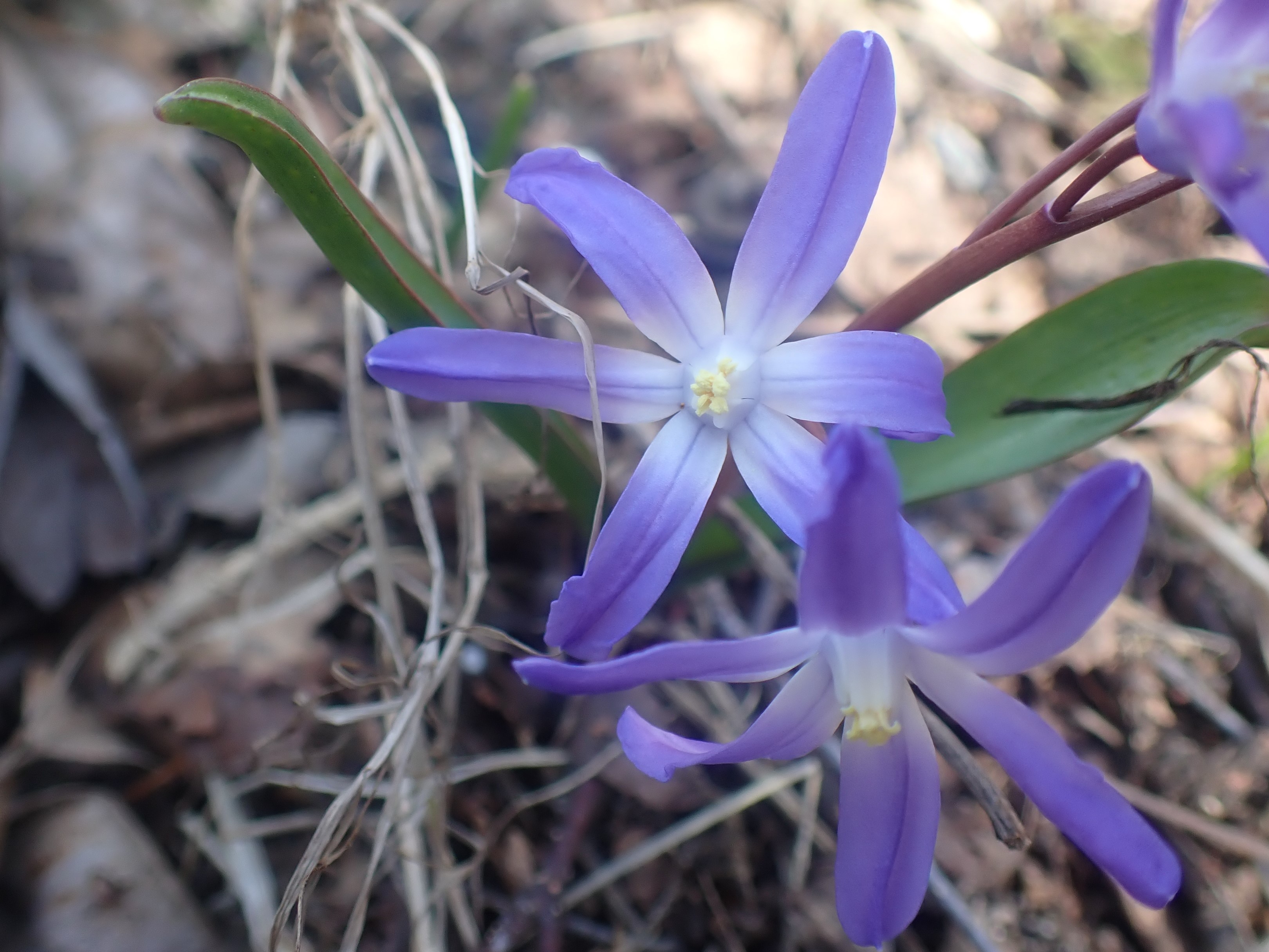
There were a few plants with glaringly whitish centres to the flowerhead which had me quite confused. Initially I thought they were a white-centred form of Scilla sardensis, though that felt 'wrong', but they keyed to Scilla forbesii. I pinged lots of images (of various Scilla species) to a couple of BSBI VC Recorders who, between them, cover the Inverness area. Happily the answer that came back for this particular plant was indeed Scilla forbesii
Glory-of-the-snow Scilla forbesii
Then there was this Scilla which looked to be a good candidate for Scilla forbesii, but clearly looks different to the white-centred Scilla forbesii shown above
In the field, this plant stood out as having longer tepals and being more graceful-looking than everything else around it. However, Scilla forbesii seemed to be the best fit when keying it through and that's exactly what the experts said it was. Personally speaking, it seems a very different beast from the white-centred plants an I suspect that either a degree of hybridisation has occurred or Scilla forbesii is particularly variable, I have no idea. On the face of it, they appear to my eye to be different species. It's a delicately beautiful plant, whatever it is.
I found a few other oddities in the small woodland area including a single bush of Kerria Kerria japonica, the first I've seen for a number of years. The crocuses here have been previously determined as hybrid Crocus neopolitanus x tommasinianus, I saw several clumps but reserved judgement on their ID. One for greater minds than mine...
I still had one more Scilla to seek, this one in nearby Culloden. I found the site easily enough but homing in on the grid reference required crossing several barbed wire fencelines. Luckily I'm used to that, what with living on Skye. Eventually I was at the appointed spot. The plants here were supposed to be Scilla forbesii and I wanted to see a known population in order to make more sense of the Inverness plants I'd just come from. But what I found was a very different plant indeed
This simply cannot be Scilla forbesii, as is stated on the BSBI database. The anthers are inserted at the base and are free from the ovary which conclusively rules out forbesii (which is a Chionodoxa and not a true Scilla). The pendant heads were enough to tell me what these plants were and a run through the key quickly confirmed my suspicions
1) Tepals free, stamens inserted at their base >>4
Back home that evening, I contacted the BSBI chaps and informed them of the apparent error on their database. Happily, nobody seemed upset with me and the correct identity has now been uploaded to the BSBI database. They believe it was an inputting error rather than an actual misidentification in the field.
Whilst I was in Culloden I couldn't help but notice large numbers of white crocuses scattered around the woodland edge, probably deliberately thrown out and only dubiously naturalised, though spreading quite prolifically where they do occur. There were also a few lilac/purple coloured crocuses under trees, looking slightly less plastic than the white ones. I think they are Early Crocus Crocus tommasinianus mixed with Spring Crocus Crocus neopolitanus, though the taxonomy for these is a complete mess and the huge number of cultivars leaves me just a tad bewildered.
Crocus 'sp'
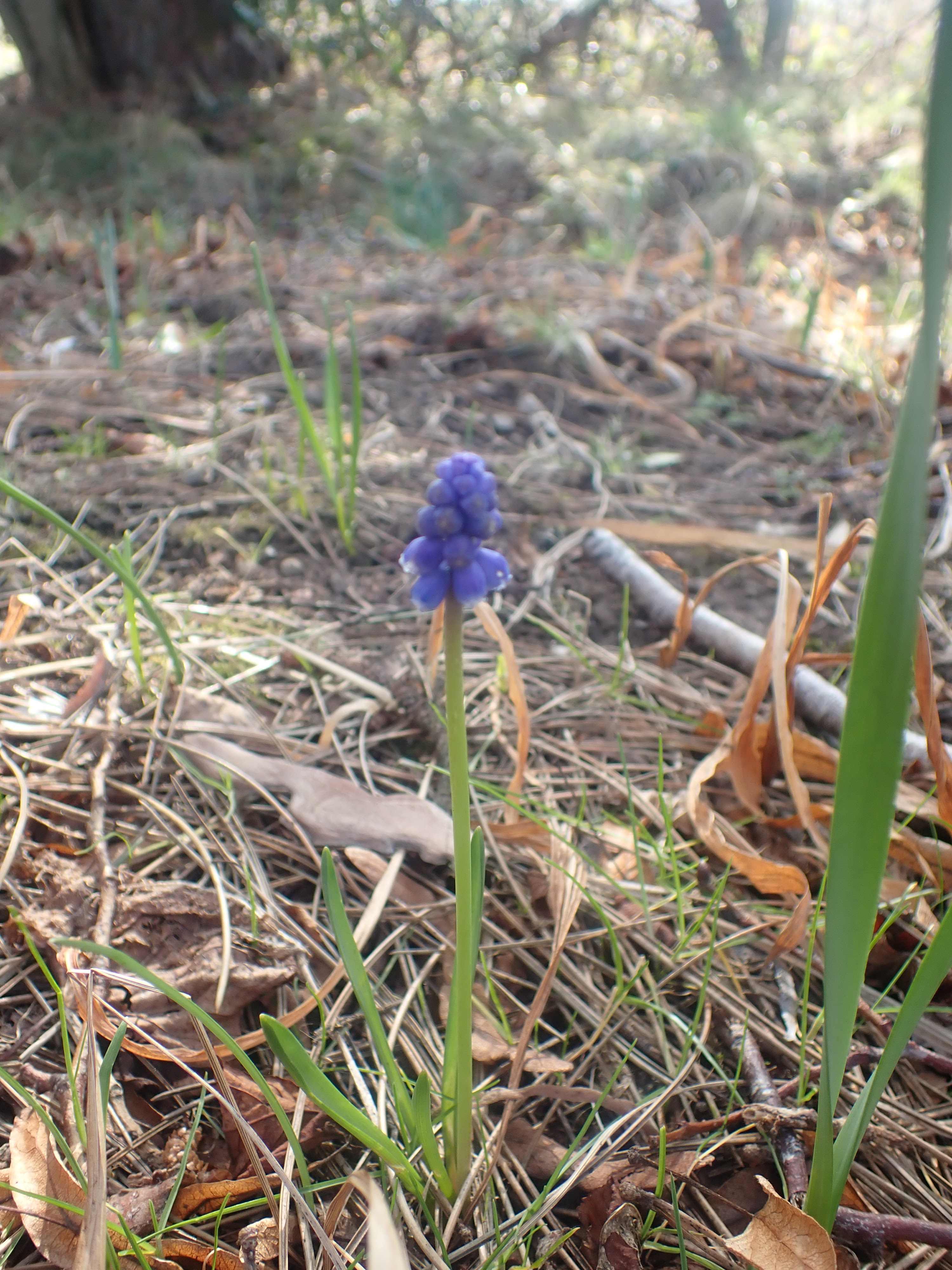
I also spotted this lone Garden Grape Hyacinth along a woodland path, quite a way from the nearest garden and looking just a bit lost. It belongs in the squill family, so it is fitting that I found it on my squill-fest day.
Garden Grape-hyacinth Muscari armeniacum
My tickfest in the world of Scilla was concluded. In truth, I was a little relieved - I was still pretty unsure of the ID of a few plants and would remain that way until the following day after contacting the BSBI chaps. I headed into Inverness itself to check out an alleyway that held several plants of interest.
This is Few-flowered Garlic Allium paradoxum - and a lifer for me
The Few-flowered Garlic proved to be No-flowered Garlic, I was a month or so too early to catch the flowers. Upon my arrival, I was initially concerned that it could prove tricky to track down. Ha! There must have been at least a hundred metres of the stuff growing along one particular section of alleyway. Then I spotted the woodland floor next to the alleyway...
I think this is what's called wall-to-wall.....
With the garlic (very) safely in the bag, I headed further down the alleyway in search of my other target plant. This one took a bit of searching for, in fact I walked straight past it twice before spotting it poking out from beneath fallen leaves
This is Rockery Saxifrage, a garden cultivar of hybrid origin and a lifer for me
Flowering Currant Ribes sanguineum - quite a lot of this in the adjacent woodland
Trailing Bellflower Campanula poscharskyana - a few of these present in an old wall
Wall-rue Asplenium ruta-muraria, again on the old wall
Purple Toadflax Linaria purpurea at base of wall in the alleyway
My day's botany was complete. I'd managed to find five different species of Scilla plus Tuberous Comfrey, Few-flowered Garlic and Rockery Saxifrage as lifers, found White Butterbur flowering for the first time and only really missed the accursed Alternate-reality Golden-saxifrage. I turned The Gibstermobile to the west and headed back to Skye, arriving just in time to catch the sunset in the mountains. Glorious.
Music time. I heard this a couple of nights ago, the first time I've listened to it in a very, very long time. Needless to say, arms were in the air and I was 'singing' away and annoying the neighbours the moment the chorus hit. Hope you enjoy, I sure did!